


 Cart
Cart
 sales@molnova.com


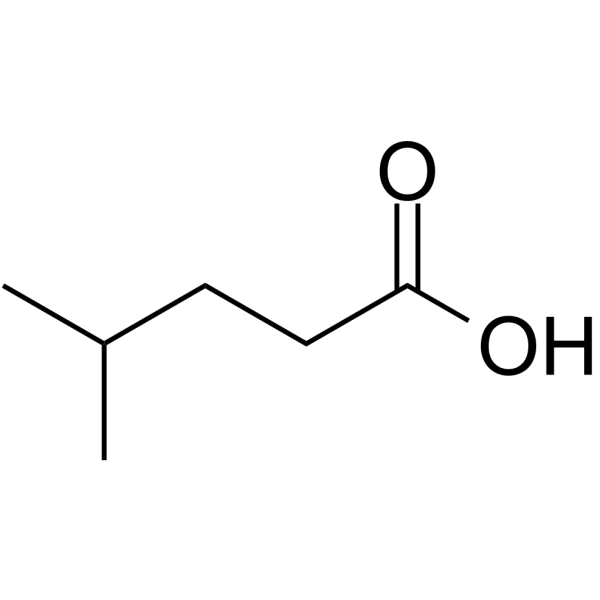
4-Methylpentanoic acid
CAS No. 646-07-1
4-Methylpentanoic acid( Isocaproic Acid )
Catalog No. M27056 CAS No. 646-07-1
4-Methylpentanoic acid is a short-chain fatty acid (SCFA) and a metabolite of 20 alpha-hydroxycholesterol.
Purity : >98% (HPLC)
 COA
Datasheet
HNMR
HPLC
MSDS
Handing Instructions
COA
Datasheet
HNMR
HPLC
MSDS
Handing Instructions
| Size | Price / USD | Stock | Quantity |
| 1G | 35 | In Stock |


|
Biological Information
-
Product Name4-Methylpentanoic acid
-
NoteResearch use only, not for human use.
-
Brief Description4-Methylpentanoic acid is a short-chain fatty acid (SCFA) and a metabolite of 20 alpha-hydroxycholesterol.
-
Description4-Methylpentanoic acid is a short-chain fatty acid (SCFA) and a metabolite of 20 alpha-hydroxycholesterol.
-
In Vitro——
-
In Vivo——
-
SynonymsIsocaproic Acid
-
PathwayOthers
-
TargetOther Targets
-
RecptorHuman Endogenous Metabolite
-
Research Area——
-
Indication——
Chemical Information
-
CAS Number646-07-1
-
Formula Weight116.16
-
Molecular FormulaC6H12O2
-
Purity>98% (HPLC)
-
SolubilityIn Vitro:?DMSO : 100 mg/mL (860.88 mM)
-
SMILESCC(C)CCC(O)=O
-
Chemical Name——
Shipping & Storage Information
-
Storage(-20℃)
-
ShippingWith Ice Pack
-
Stability≥ 2 years
Reference
1.Roth G, et al. Morphology and axonal projection pattern of neurons in the telencephalon of the fire-bellied toad Bombina orientalis: an anterograde, retrograde, and intracellular biocytin labeling study. J Comp Neurol. 2004 Oct 4;478(1):35-61.
molnova catalog



related products
-
4-Chlorocatechol
4-Chlorocatechol is a major degradation product of 4-chloro-2-aminophenol (4C2AP). 4-Chlorocatechol is also a substrate for catechol 1,2-dioxygenases and chlorocatechol dioxygenase.
-
Biotin-PEG2-OH
Biotin-PEG2-OH is a PEG-based PROTAC linker that can be used in the synthesis of PROTACs.
-
KRN-633
KRN-633 is an effective VEGFR inhibitor. The IC50s of KRN-633 for VEGFR1, VEGFR2, and VEGFR3 is 170, 160 and 125 nM, respectively.
